Bitcoin Price: Christmas Rally or 2026 Breakout?
Will Bitcoin price see a Christmas rally or peak in early 2026? Explore expert forecasts, halving cycle trends and risks before you plan your next move.

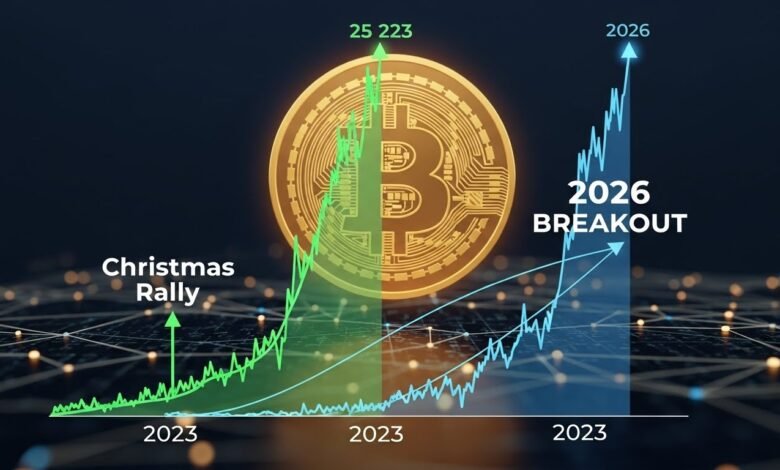
The Bitcoin price has had another wild year. After setting new all-time highs above six figures in 2025, the market has swung between euphoria and fear. Recent weeks have been especially turbulent: in late November, Bitcoin briefly surged above $90,000 during the U.S. Thanksgiving period, only to slump below $86,000 at the start of December in a sharp crypto sell-off.
With the holidays approaching, traders are asking the same seasonal question: will we get a Bitcoin Christmas rally, or will the real move wait until early 2026? At the same time, analysts are publishing bold forecasts that tie the next big leg of the Bitcoin bull run to the aftermath of the April 2024 halving and growing institutional demand.
Nothing here is financial advice. Instead, think of it as a structured guide to the current narrative around Bitcoin, aimed at helping you ask better questions and build your own view of where the Bitcoin price might go next.
Bitcoin price in late 2025: where we stand now
A volatile year with new highs and sharp pullbacks
2025 has been a textbook year of crypto market volatility. Bitcoin hit a fresh all-time high above $126,000 in early October, driven by strong inflows into spot Bitcoin ETFs, rising institutional interest and optimism around pro-crypto regulation.
After that, the trend turned choppy. November was one of Bitcoin’s worst months of the year, with the Bitcoin price losing more than 16% before attempting a recovery and then dropping again below $86,000 in early December. Analysts pointed to weaker ETF inflows, excessive leverage and macro uncertainties as key factors behind the sell-off.
Despite these swings, the big picture is still that Bitcoin is trading massively higher than it was before the 2024 halving and the wave of ETF approvals. The market is wrestling with a classic dilemma: is this just a mid-cycle correction in a larger Bitcoin bull market, or the start of something more serious?
Sentiment heading into the holiday season
On the bullish side, analysts at several research houses still talk about a “significant bull market” with upside targets as high as $200,000–$225,000 before the current cycle is over.
On the cautious side, others warn that after such a rapid run-up, Bitcoin may already have front-run much of the post-halving rally and could spend more time consolidating or even enter a deeper correction before any new highs. Some Elliott Wave-based forecasts, for example, see a potential cycle top around $140,000 and a painful 2026.
This tension between bullish long-term narratives and short-term caution is exactly what makes a potential Christmas rally so interesting—and so controversial.
What is a Bitcoin Christmas rally?
How holiday rallies work in traditional markets
In traditional stock markets, a “Santa Claus rally” refers to a tendency for prices to rise in the last week of December and the first couple of days of January. Explanations range from lower trading volumes and year-end portfolio rebalancing to improved risk appetite as the new year approaches.
Crypto markets are very different, trading 24/7 with a global audience and fewer institutional constraints, but the idea of a holiday rally has filtered into Bitcoin as well. A Christmas rally in Bitcoin usually means a sudden upside burst in the second half of December, often sparked by short covering, improved sentiment, or simply the market drifting upward in thin liquidity.
How holiday moves have played out in past cycles
Historical analyses of Bitcoin’s four-year halving cycle show that the strongest rallies tend to cluster around 6–18 months after a halving event, but not always specifically in December. The 2016–2017 and 2020–2021 cycles, for example, saw powerful moves that ran well beyond the holiday period, supporting the idea that timing a rally to Christmas alone is unreliable.
In other words, Christmas is a story, not a guarantee. What really matters is where we are in the broader cycle and how macro and crypto-specific factors line up.
The case for a 2025 Christmas rally
Technical factors that could support a year-end bounce
From a purely market-structure perspective, several factors could support a year-end bounce in Bitcoin price:
After the sharp drop below $86,000, many analysts are watching that zone and the nearby $80,000 support as a potential “higher low” area within the broader uptrend. A successful defense of that region could set the stage for a relief rally back towards $90,000–$100,000.
Short-term positioning also matters. When funding rates reset and leveraged longs are flushed out, the market often becomes more balanced. If derivatives data show reduced excessive leverage, the path of least resistance can shift upward again, particularly in quieter holiday trading when relatively small flows can move the market.
From a psychological standpoint, Bitcoin has a history of producing “surprise” moves when sentiment is leaning too strongly in one direction. If the dominant narrative becomes “no Christmas rally,” the stage is ironically set for a short squeeze.
On-chain and ETF flows to watch
Beyond charts, several on-chain metrics and ETF-related signals could help confirm or reject the Christmas rally thesis:
If spot Bitcoin ETF inflows pick up again after the recent slowdown and outflows, that would signal renewed institutional demand after a period of profit-taking. The earlier surge of capital into products like BlackRock’s iShares Bitcoin Trust was a major driver of the rally to new highs.
On-chain, metrics such as long-term holder supply, realized price, and short-term holder capitulation can show whether strong hands are accumulating into weakness. Research on post-halving behavior suggests that sustained accumulation by long-term holders has historically preceded the steepest legs of the Bitcoin bull run.
If these data points turn more positive into late December, the probability of a short-term Christmas rally in Bitcoin price increases. But even then, that move might be just a prelude to a bigger story that many experts place in early 2026.
Why many experts are looking to early 2026 instead
The post-halving lag and the four-year cycle
One of the most powerful narratives in Bitcoin is the four-year halving cycle. Every four years, the block reward is cut in half, reducing the rate of new Bitcoin entering circulation. The most recent halving occurred on April 20, 2024, dropping the block subsidy from 6.25 BTC to 3.125 BTC per block.
Many cycle-based analysts therefore argue that the true peak of the current post-2024 halving bull market is more likely to occur sometime in 2026, not necessarily in late 2025. Research pieces that model Bitcoin’s path through 2025–2026 often point to a scenario where 2025 is strong but volatile, with consolidation and corrections, before a final powerful move in the following year.
This doesn’t rule out a Christmas rally in 2025, but it frames it as a waypoint, not the destination.
Price targets and scenarios for 2026
What could “early 2026” look like if this post-halving bull market continues?
Forecasts vary widely, but several recent analyses cluster around a range of $150,000–$250,000 as a plausible peak zone if bullish conditions persist. Some reports even explore scenarios where the Bitcoin price overshoots towards $300,000 in a euphoric blow-off top before cooling as the cycle matures.
Examples of publicly discussed 2026 views include:
Some cycle-based models argue that Bitcoin could reach between $112,000 and $258,000 in an “extreme greed” zone, potentially stretching as high as $300,000 before fading into 2026.
Other analysts, like those cited by Investing Haven and similar macro-charting platforms, project that Bitcoin could exceed $200,000 in 2026, assuming the U.S. dollar remains relatively weak and institutional adoption keeps rising.
On the more cautious side, technical forecasts from outlets like Coin Desk and others using Elliott Wave frameworks suggest a high around $140,000, followed by a difficult 2026 as the market digests the prior gains.
There is no consensus—and there never is in crypto—but a common thread is that the cycle may still have time left, which is why so many experts talk about early 2026 as a key window rather than pinning everything on this year’s holiday period.
Key risks that could derail both a Christmas rally and a 2026 bull run
Even the strongest Bitcoin bull run narratives come with a long list of risks. Understanding these helps you evaluate whether a Christmas rally or early-2026 peak is realistic.
Macro uncertainty remains a major factor. Changes in interest-rate expectations, recessions, or sudden liquidity shocks can push investors out of risk assets. Bitcoin’s recent slide below $86,000 was partly blamed on global risk aversion and shifts in traditional markets, reminding traders that crypto does not exist in a vacuum.
Regulatory surprises are another wildcard. While 2024 and 2025 saw big wins like spot ETF approvals and more open crypto policies in major markets, the landscape can change quickly. New rules around stable coins, exchange operations, or taxation could weigh on sentiment and reduce the growth of institutional participation that many early-2026 price forecasts rely on.
Market-structure risks are also real. If excessive leverage builds up again—like the 100x or 200x leverage seen on some platforms—then any sharp move can cascade into liquidations, causing violent crashes that interrupt otherwise healthy uptrends.
Finally, there is the psychological risk of expectations themselves. If too many traders fixate on big numbers like $200,000 or $300,000 Bitcoin, even a strong rally that stops at, say, $150,000 could feel like a disappointment and trigger heavy profit-taking.
How traders and long-term investors can approach this setup
Given the uncertainty around a Christmas rally and the mixed forecasts for early 2026, how can different types of market participants think about the Bitcoin price from here?
Short-term traders often focus on levels and catalysts rather than calendar dates. For them, the key is watching support zones like $80,000–$86,000, resistance around $90,000–$100,000, and data such as ETF flows, funding rates, and on-chain activity. A short, sharp holiday rally might offer opportunities, but it also carries elevated risk if liquidity is thin and price spikes are driven more by sentiment than fundamentals.
Medium-term swing traders and position traders might treat the rest of 2025 as part of a broader post-halving consolidation, looking to build or adjust exposure gradually rather than trying to time the exact bottom or top. In this context, a Christmas rally would be useful information about market strength, but not necessarily a reason to overhaul a well-planned strategy.
Long-term investors who believe in the Bitcoin halving cycle and the story of digital scarcity tend to zoom out even further. For them, the key questions are whether the supply-demand dynamics remain favorable, whether institutional adoption continues, and whether Bitcoin’s role as a macro hedge or “digital gold” is strengthening. Their focus is more on multi-year horizons (toward 2026, 2030 and beyond) than on whether December alone delivers a big move. Regardless of timeframe, sensible risk management—position sizing, diversification, and clarity about your own time horizon—matters more than guessing whether Santa will show up for Bitcoin this year.
Conclusion
So, will the Bitcoin price get a Christmas rally, or will the real fireworks wait for early 2026?
A short-term Christmas rally is possible, especially if selling pressure continues to ease, ETF flows stabilize, and traders reposition in thin holiday markets. Technicals and sentiment could align for a bounce after the latest drop. However, many expert forecasts, cycle analyses, and halving-based models point to 2026 as the more likely window for a major cycle peak, potentially in the $150,000–$250,000 or even higher range—though conservative scenarios see lower tops and a more painful comedown. In other words, a Christmas rally, if it happens, might be just one chapter in a much larger story shaped by the 2024 halving, institutional adoption, and macro conditions. As always, do your own research, consider your risk tolerance, and remember that no model or expert can predict the Bitcoin price with certainty. Markets can and do surprise everyone—on Christmas, in early 2026, and beyond.
FAQs
Q. Is a Bitcoin Christmas rally guaranteed?
No. While traders love the idea of a Bitcoin Christmas rally, there is no guarantee it will happen in any given year. Historical data shows that some Decembers have been very bullish during strong Bitcoin bull markets, while others have been flat or even bearish when Bitcoin was already extended or entering a corrective phase. Calendar effects exist, but they are weaker than deeper drivers like the halving cycle, macro trends and ETF flows.
Q. Why are experts focused on early 2026 for Bitcoin’s peak?
Many analysts believe that Bitcoin’s strongest price moves typically occur 12–18 months after a halving, and the latest one happened in April 2024. That timing points to 2025–2026 as the heart of the current cycle, with a significant probability that the final peak might land in early or mid-2026 rather than at the end of 2025. Various research reports place potential peak ranges between about $150,000 and $250,000, with some outlier models pointing even higher.
Q. Could Bitcoin crash in 2026 instead of rallying?
Yes, that is a real possibility. Some cycle models and Elliott Wave analyses warn that after a strong run into late 2025, Bitcoin might top out and experience a painful bear market in 2026, echoing what happened after previous peaks. These views see the upside as limited—perhaps around $140,000—followed by a deeper correction as the cycle matures and speculative excess is unwound.
Q. What indicators should I watch to gauge the odds of a Christmas rally?
If you are watching for a Christmas rally in Bitcoin price, key indicators include ETF inflows and outflows, funding rates and open interest in futures, on-chain metrics such as long-term holder supply, and price behavior around key support and resistance zones like $80,000–$86,000 and $90,000–$100,000. Improving ETF inflows, reduced excessive leverage, and signs of accumulation by long-term holders would all support the case for a short-term bounce.
Q. Is now a good time to buy Bitcoin before 2026?
Whether now is a good time to buy depends entirely on your personal situation, risk tolerance and time horizon. From a narrative standpoint, many experts still see the current environment as part of a broader post-halving bull market, with potential upside into 2026. At the same time, the recent volatility and conflicting forecasts show that downside risk remains significant. Tools like dollar-cost averaging, diversification and clear exit plans can help manage that risk, but they do not remove it. Always do your own research and, if needed, consult a licensed financial professional before making major investment decisions.