What Is Market Analysis A Clear Guide for Smart Decisions


If you’ve ever wondered what market analysis is, think of it as the bridge between your idea and the reality of your customers, competitors, and the broader industry. Market analysis turns raw observations—what people buy, why they buy, and how they compare alternatives—into structured insights that guide confident decisions. Whether you are launching a startup, entering a new region, pricing a product, pitching investors, or planning a growth campaign, a rigorous understanding of the market answers crucial questions before you commit valuable time and budget.
At its core, market analysis pulls together data on demand, customer segments, competitor moves, pricing dynamics, and distribution channels, then interprets it to reveal opportunities and risks. By the end of this article, you will know what market analysis is, how to conduct one from scratch, which frameworks and data sources to use, how to avoid common pitfalls, and how to turn findings into a strategy that actually moves the needle.
Table of Contents
ToggleWhat Is Market Analysis?
When people ask what market analysis is, the most straightforward answer is that it’s a systematic evaluation of your market’s size, structure, trends, and players. The goal is to quantify demand, profile customers, map competitors, and identify the forces that shape profitability. Unlike casual research, a professional market analysis is structured, repeatable, and tied to business decisions such as product positioning, pricing, and go-to-market execution.
A full analysis typically blends primary research—speaking directly with customers, conducting surveys, and interviewing channel partners—with secondary research, including industry reports, public data, competitor websites, review platforms, search trends, and sales benchmarks. The result is a narrative and a set of numbers that explain where value is being created, by whom, and under what conditions.
Why Market Analysis Matters at Every Stage
Understanding what is market analysis is only the first step. The real power lies in using it at key decision points. Early-stage founders use market analysis to validate problems and size opportunities before building. Growth teams rely on it to refine niches, improve conversion, and reduce churn. Established brands turn to market analysis when they face new entrants, shifting regulations, or evolving buyer behaviour.
A robust analysis reduces uncertainty. It exposes blind spots, surfaces unmet needs, and prevents expensive mistakes, such as entering a saturated segment with no clear differentiation. It also builds credibility with stakeholders. Investors, lenders, and leadership teams expect a clear, defensible view of the market, backed by data and sound logic.
Core Components of a Market Analysis

Defining the Market and Its Boundaries
A surprising amount of confusion around what market analysis is comes from a fuzzy market definition. Start by drawing tight boundaries. Specify the product or service category, the customer segment, and the geography. If you sell a B2B SaaS for mid-market manufacturers in North America, say so. Clear boundaries keep data consistent, prevent apples-to-oranges comparisons, and ensure that your numbers—especially market size—are meaningful.
Clarify whether you are analysing a total addressable market (TAM), a serviceable available market (SAM) that fits your model and distribution, and the serviceable obtainable market (SOM) you can realistically capture within a specific period. These nested definitions translate abstract ambition into practical targets.
Customer Segmentation and Jobs to Be Done
At the heart of market analysis is the buyer. Segmentation goes beyond demographics. You want to understand psychographics, behaviours, and jobs-to-be-done—the underlying tasks customers are trying to accomplish. For consumer offerings, categories like life stage, values, and lifestyle are highly predictive. For B2B, segment by firmographics such as industry, headcount, revenue band, tech stack, and procurement process.
Use interviews to probe triggers, barriers, and success criteria. Ask customers what outcomes matter most, how they evaluate alternatives, and what would make them switch. These insights fuel sharper messaging, more relevant features, and better channel choices.
Competitor Mapping and Positioning
Another frequent angle in market analysis is the competitive landscape. Identify direct competitors offering similar solutions and indirect competitors that solve the same problem in a different way, including the ever-present alternative of doing nothing. Build profiles that cover pricing models, feature sets, distribution, customer satisfaction, and brand perception.
What matters is not listing features but understanding positioning—who each competitor is for, what promise they make, and why buyers believe them. This picture reveals gaps you can exploit, such as an underserved segment, a neglected channel, or a pain point competitors gloss over.
Market Size, Growth, and Seasonality
Sizing the market is often the most visible part of what is market analysis. Combine top-down estimates from reputable reports with bottom-up models using your actual or projected unit economics. If you know how many potential buyers exist, their average annual spend, and the share you can capture, you can logically build a forecast.
Always examine growth rates and seasonality. A steady but slow-growing market may still be attractive if customer lifetime value is high and churn is low. Conversely, a fast-growing market can be treacherous if it’s also volatile, heavily regulated, or winner-takes-most.
Pricing Dynamics and Willingness to Pay
No discussion of what is market analysis is complete without pricing. Investigate current price ranges, discounting behaviour, and the link between price and perceived value. Use techniques like Van Westendorp price sensitivity or conjoint analysis when possible. In B2B, map how procurement, budgeting cycles, and ROI cases influence willingness to pay.
The output isn’t a single price point but a pricing architecture—tiers, bundles, usage metrics, and add-ons—that aligns with your personas and purchase triggers.
Channels and Go-to-Market Motion
A thorough view of what is market analysis examines how products move from vendor to buyer. Are purchases driven by self-serve product-led growth, direct sales, resellers, or marketplaces? Each path imposes constraints on margins, cash flow, and speed. Your analysis should quantify the acquisition cost, sales cycle length, and post-purchase expansion patterns across the channels available to you.
Regulatory, Technological, and Macro Forces
Finally, step back and analyse the macro context. Regulations can alter market boundaries overnight. Technological shifts can compress costs, enable new entrants, or make incumbents more formidable. Economic cycles affect budgets and risk appetite. Folding these forces into your thinking completes the picture of what market analysis is in practice.
Step-by-Step: How to Conduct a Market Analysis
1: Frame the Problem and Hypotheses
Start with a one-page brief. State your goal, your key questions, and initial hypotheses. Clarify scope: customer segment, product category, geography, and time horizon. When stakeholders align on the frame, every subsequent step becomes faster and more coherent.
2: Map Data Sources and Research Methods
List the sources you’ll use, balancing primary research with secondary research. Plan interviews, short surveys, and, if possible, usability sessions to get qualitative colour that numbers alone cannot provide. On the secondary side, collect industry reports, trade association updates, competitor collateral, public financials for larger rivals, search trend data, and review site insights. The mix ensures your analysis captures both the forest and the trees.
3: Build Buyer Personas From Evidence
Translate raw findings into two to four evidence-backed personas. Include role or life stage, goals, pain points, success metrics, and buying triggers. Connect personas to specific channels and messages they trust. Tie every claim to actual quotes or data so the personas are more than fiction.
4: Quantify TAM, SAM, and SOM
Craft a top-down view using credible market figures and a bottom-up view that multiplies the number of reachable buyers by expected annual spend. Sanity-check both approaches against each other. If the numbers diverge wildly, revisit your assumptions about market boundaries or pricing.
5: Analyse Competitors With a Positioning Lens
Create comparable snapshots for each significant rival: who they target, what promise they make, how they charge, and where they win or lose. Plot the field with a perceptual map to visualize white space. Be sure to include substitutes and status quo behaviours, because in many markets, the biggest competitor is inaction.
6: Test Pricing and Willingness to Pay
Use qualitative interviews to gather ranges and objections, then validate with quantitative techniques if feasible. Look for thresholds where perceived value jumps or collapses. Convert findings into tiered packages that reflect genuine differences in outcomes, not just arbitrary feature gates.
7: Model Acquisition, Conversion, and Retention
Estimate traffic or leads by channel, expected conversion at each stage, sales cycle time, and retention patterns. Incorporate customer acquisition cost and lifetime value to test sustainability. This turns what is market analysis into a living, testable model of how your business captures value.
8: Synthesise Insights Into Strategy
Close with crisp recommendations: which segments to prioritise, how to position, what to ship first, where to price, and which channels to lean into. Link every recommendation to a data point or a pattern you observed. Good analysis doesn’t drown stakeholders in facts; it distils them into an agenda.
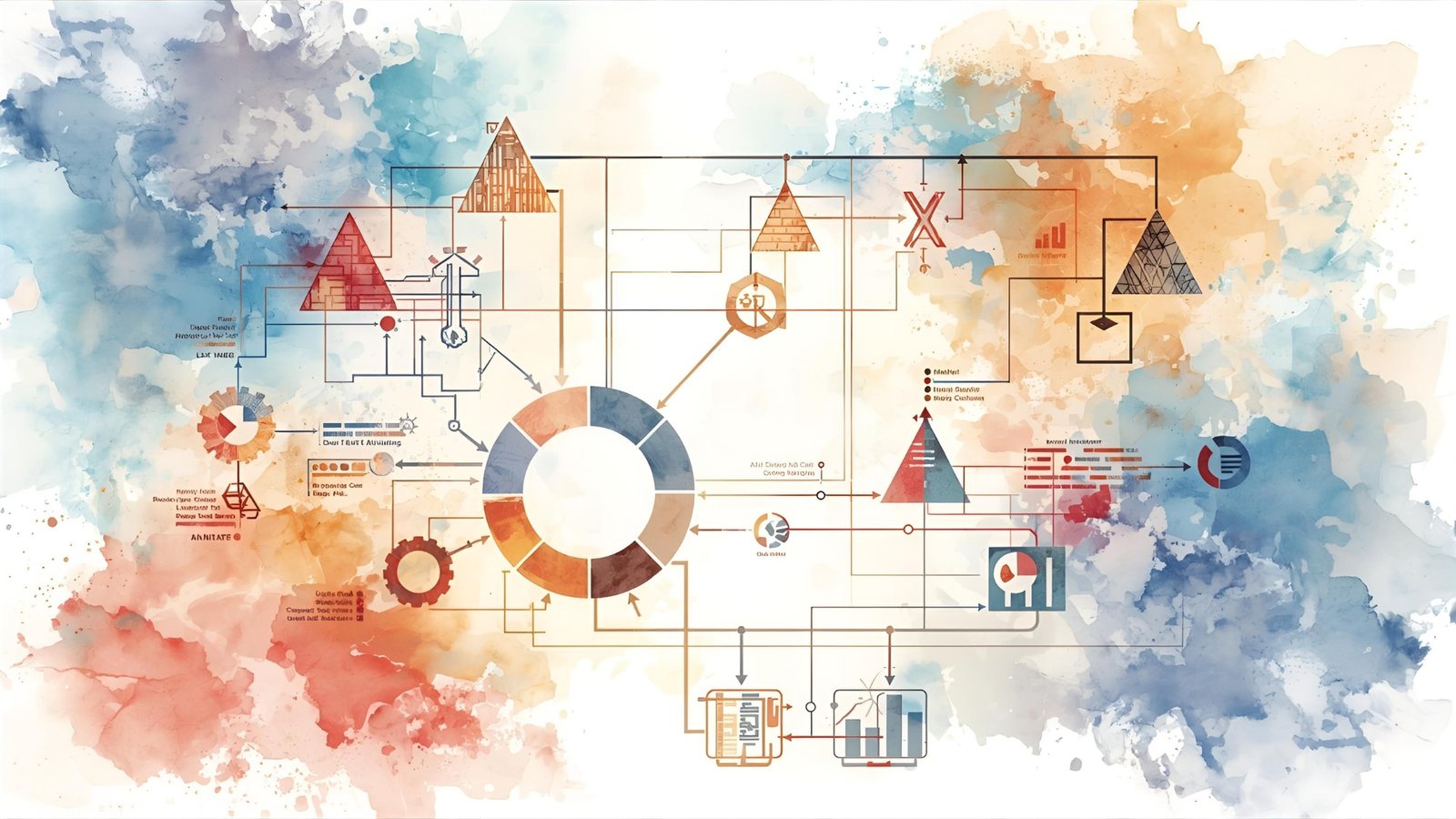
Frameworks That Sharpen Market Analysis
SWOT: Strengths, Weaknesses, Opportunities, Threats
SWOT remains useful when anchored in data. Strengths and weaknesses are internal realities like brand equity or cost structure. Opportunities and threats are external shifts, such as emerging technologies or new regulations. Pair SWOT with evidence from interviews and metrics, not opinions.
Porter’s Five Forces for Structure and Profitability
To truly grasp what is market analysis, evaluate industry structure with Five Forces: rivalry, threat of new entrants, bargaining power of suppliers and buyers, and threat of substitutes. These forces hint at long-term profitability. In markets with high switching costs and powerful network effects, incumbents enjoy durable advantages; in fragmented, low-barrier categories, margins compress quickly.
PESTLE: Macro Forces That Shape Demand
PESTLE—political, economic, social, technological, legal, and environmental factors—helps anticipate shocks and tailwinds. For example, privacy legislation alters ad targeting strategies, while demographic shifts change lifetime value calculus. Incorporating PESTLE in your market analysis prevents near-sighted plans.
Jobs to Be Done: Understanding Real Motivation
Jobs to be Done reframes your analysis around the outcomes customers hire your product to achieve. This lens cuts through demographic noise and reveals true switching criteria. When you know the job, positioning and messaging become obvious.
Data Quality and Research Rigor
A credible answer to what is market analysis depends on data integrity. Triangulate numbers from multiple sources, annotate assumptions, and keep a change log when you refine models. Watch for survivorship bias, response bias in surveys, and sampling errors. If you are making a big bet, consider commissioning a statistically robust survey or working with a third-party research firm to validate your conclusions.
Turning Analysis Into Action
From Insights to Roadmap
Translate insights into a roadmap with clear priorities. If interviews show that onboarding friction kills adoption, prioritize activation features and educational content. If a segment shows a strong willingness to pay for speed, build and price for performance. Tie every roadmap item back to the market finding that justifies it.
Storytelling for Stakeholder Buy-In
Your audience needs more than tables; they need a narrative. Explain what is market analysis by telling the story of your buyer: their context, constraints, and desired outcomes. Use a simple structure—problem, evidence, solution, expected impact—to align cross-functional teams.
Metrics and Instrumentation
Instrument your funnel so you can validate predictions quickly. Define leading indicators such as trial-to-paid conversion, net revenue retention, and cohort activation rates. When reality diverges from your model, update the analysis. The most valuable market analysis is a living document, not a static deck.
Common Pitfalls to Avoid
One misconception about what is market analysis is that more data is always better. Without a clear question, extra data only adds noise. Another pitfall is confirmation bias. If you set out to prove a predetermined thesis, you’ll miss contradictory signals. Beware of overstated TAMs that are irrelevant to your actual route to market. Finally, resist copying competitors’ pricing or messaging without validating what works for your own segments.
Real-World Examples of Market Analysis in Action
Consider a company offering AI-assisted analytics to mid-market e-commerce brands. Early research might show that operations leaders care less about exotic models and more about reliable forecasts that reduce stockouts. Competitive mapping reveals that many vendors pitch to data teams with technical jargon. The company positions itself around inventory accuracy and forecast reliability, packages by monthly order volume, and sells through partnerships with 3PLs. That is what is market analysis turning into a tangible edge.
Or imagine a personal finance app targeting recent graduates. Interviews surface anxiety about credit scores and budgeting for rent. Review data shows frustration with hidden fees. The team focuses on transparent pricing, a credit-building toolkit, and a friendly onboarding that explains trade-offs in plain language. Channels emphasize creator partnerships and university ambassadors. Again, analysis informs strategy.
Advanced Topics: Segment Profitability and Moats
Once you grasp what is market analysis, the next level is segment profitability. Not all revenue is equal. Some segments offer high lifetime value but are expensive to acquire; others are cheap to acquire but churn quickly. Build a segment P&L to see which customers truly create durable value. Then, examine moats—switching costs, network effects, exclusive data, or ecosystem positions—that protect your gains. Knowing where you can build defensibility elevates your strategy from short-term wins to lasting advantage.
Ethical Considerations and Brand Trust
A modern take on what is market analysis must consider ethics. Respect privacy in data collection, communicate how you use insights, and avoid manipulative tactics. Long-term loyalty flourishes when customers feel understood, not exploited. Ethical choices are not just moral; they are strategic assets that differentiate your brand.
Putting It All Together
By now, what is market analysis should feel less like a textbook term and more like a practical discipline that you can apply. Define the market clearly. Talk to customers and listen for jobs to be done. Map competitors by positioning, not just features. Size the prize with TAM, SAM, and SOM. Test pricing, model acquisition and retention, and translate insights into a focused roadmap. Keep your analysis alive with metrics, and refresh it when signals change.
Final Thought
Understanding what is market analysis empowers smarter choices at every stage of growth. It is the structured practice of turning scattered signals—customer pains, competitor moves, pricing patterns, and macro forces—into a clear plan you can act on. The best analyses are grounded in real conversations, sharpened by frameworks, and validated by numbers. When you approach your market with rigor and empathy, you reduce risk, build trust, and create products that win for the right reasons.
FAQs
What is market analysis in simple terms?
Market analysis is a structured way to understand your buyers, competitors, and industry so you can make better business decisions. It combines customer research, market sizing, pricing insight, and channel evaluation into a coherent strategy.
How is market research different from market analysis?
Market research gathers data through surveys, interviews, and reports. Market analysis interprets that data to answer strategic questions about where to play and how to win. Research feeds analysis; analysis guides decisions.
How often should I update a market analysis?
Update it whenever key assumptions change—new competitors, shifting regulations, pricing pressure, or a major product release. As a rule of thumb, revisit quarterly for fast-moving markets and semiannually for stable ones.
What data sources are best for a first analysis?
Start with ten to fifteen customer interviews, public industry reports, competitor websites, review platforms, search trends, and any internal sales or support tickets. Triangulating these sources creates a reliable foundation.
How do I turn findings into action?
Link each recommendation to a specific insight. Prioritise segments with the strongest willingness to pay and the healthiest unit economics. Adjust positioning, pricing, and channels accordingly, and instrument metrics to validate the impact.
Also Read : Latest Bitcoin News and Analysis Market Updates & Expert Insights 2025