Santiment Flags BTC and XRP in ‘Good Buy Zone’
Santiment says BTC and XRP are in a “good buy zone” after the latest crypto sell-off. Discover what the data shows, plus key risks before you buy.

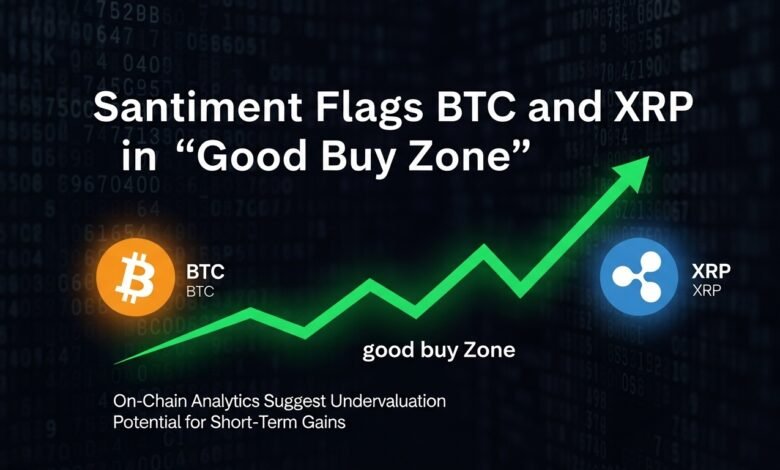
Santiment Flags BTC .The recent crypto market sell-off has shaken traders’ confidence. Bitcoin (BTC) dropped sharply, XRP extended a losing streak, and many portfolios slid deep into the red. Yet, while fear dominates social media and headlines, on-chain analytics firm Santiment is flashing a different signal: “good buy zone” for both Bitcoin and XRP.
According to Santiment’s data, the 30-day MVRV ratio (Market Value to Realized Value) for BTC and XRP has fallen into negative territory, meaning that traders who bought in the last month are sitting on notable unrealized losses. Historically, Santiment classifies these levels as a good buy zone, often associated with strong accumulation phases and potential rebounds.
At the same time, sentiment metrics show low greed and elevated fear around Bitcoin price and XRP price, especially compared to more hyped altcoins like Ethereum. This combination of deep pullbacks, negative returns, and bearish crowd sentiment is exactly the backdrop Santiment often points to when it talks about buy-the-dip opportunities. Santiment Flags BTC.
In this article, we’ll break down what it means when Santiment flags BTC and XRP in “good buy zone” despite sell-off, how key indicators like MVRV and crowd sentiment work, and what risks traders should keep in mind. This is not financial advice, but a deeper look at the data behind the headlines so you can make more informed decisions in a volatile market.
What Does “Good Buy Zone” Mean in Crypto?

Understanding the MVRV Ratio
The term “good buy zone” is closely tied to the MVRV ratio, one of Santiment’s flagship on-chain metrics. MVRV compares the market cap of a cryptocurrency (current price times circulating supply) with its realized cap (the value of coins based on the price at which they last moved on-chain).
When the 30-day MVRV is positive, it suggests that recent buyers, on average, are in profit. High positive MVRV often coincides with euphoric phases, where many traders are profitable and more likely to take gains, which can increase sell pressure.
When the 30-day MVRV turns deeply negative, it signals that most of the addresses that bought in the last month are holding unrealized losses. That’s precisely the type of environment Santiment calls a “good buy zone” becauseThis sudden reversal pushed the market out of the so-called “greed zone” into a more cautious, fearful state. On-chain data shows that retail traders began capitulating, locking in losses and reducing risk—behavior that has historically coincided with or preceded short-term bottoms in prior cycles. Santiment Flags BTC.
Extreme Fear as a Potential Opportunity
Other analytics and news outlets also highlight that the broader crypto market has entered a phase of extreme fear, with sentiment indices and social data reflecting rising pessimism. Yet, Santiment and other on-chain observers argue that such fear can be healthy, as it often indicates that weak hands are exiting while long-term holders are accumulating.
That contrast—bearish mood, but fundamentally strong network activity and long-term narratives—is one reason why Santiment flags them as potential buy-low candidates.
Why Bitcoin Is in a “Good Buy Zone” According to Santiment
BTC’s Short-Term Pain, Long-Term Story
Despite Bitcoin’s size and dominance, its price still moves in violent cycles. The recent sell-off pushed Bitcoin price down sharply, hurting short-term buyers and sending its 30-day MVRV into negative territory. Santiment’s data suggests these levels have previously aligned with favorable accumulation windows for BTC.
BTC Sentiment, Whales, and Retail Behavior
Santiment and other analytics providers closely track whale wallets (large holders) versus retail traders. When retail is panic-selling and big wallets are quietly accumulating, it can hint at a stealth bullish setup. Santiment Flags BTC.
That said, there are also warnings about whales occasionally using rallies to offload holdings while retail “buys the dip,” leading to short-term volatility spikes.
This mix of short-term risk and long-term opportunity is why Santiment doesn’t frame Bitcoin’s good buy zone as a guarantee, but as a historically favorable setup if you have patience and risk management.
Why XRP Is Also Flagged as a Contrarian Buy
XRP’s Deep Drawdown and Negative MVRV
XRP has been under even more pressure than BTC. Price action shows extended losing streaks and failed breakouts, which have frustrated traders and pushed sentiment into what Santiment calls “one of the most fearful moments of 2025” for the token.
In other words, many recent buyers have already taken the hit. For long-term investors, this kind of broad unrealized loss can indicate a better entry than chasing green candles at multi-month highs.
FUD, Crowd Sentiment, and Why It Might Be Bullish
On top of price losses, XRP is seeing surging FUD (fear, uncertainty, and doubt) across social channels. Several reports note that XRP’s crowd sentiment has fallen to multi-month lows, with negative commentary dominating discussions.
Santiment often interrets this as bullish from a contrarian perspective: Combined with the negative MVRV data, the XRP fear index, and growing fatigue among holders, the analytics firm concludes that XRP is sitting in a historically attractive accumulation zone, even though price action still looks weak on the surface. Santiment Flags BTC.
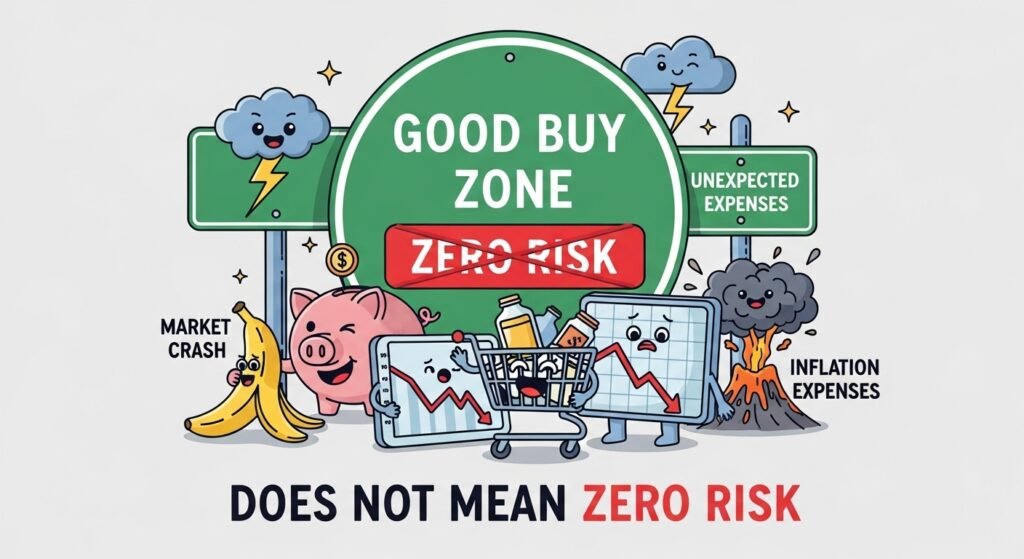
“Good Buy Zone” Does Not Mean Zero Risk
No Indicator Is Perfect
Even though Santiment’s models highlight Bitcoin and XRP in a good buy zone, it’s critical to remember that no indicator is infallible. MVRV and sentiment metrics work best as probabilistic tools, not crystal balls. There is always a risk that
Volatility, Leverage, and Emotional Trading
Crypto markets are notorious for high volatility. Traders who enter BTC or XRP solely based on a “good buy zone” headline without a plan can still be shaken out by:
That’s why many experienced investors focus on position sizing, time horizon, and risk management instead of trying to perfectly time the bottom. Tools like MVRV and sentiment can help frame the big picture but should be used alongside solid strategy—not instead of one.
Short-Term vs Long-Term Outlook for BTC and XRP
Short-Term: Choppy Price Action Likely
In the short term, the market can remain messy. Even if Santiment’s good buy zone signal proves accurate, the path from here to higher prices might not be smooth. Short-term traders should be prepared for:
For active traders, this environment demands tight risk controls and a clear plan, not blind faith in a single on-chain metric.
Long-Term: Accumulation and Network Fundamentals
For long-term holders, the story is slightly different. When Santiment points to BTC and XRP as buy-low candidates, it’s typically in the context of months to years, not hours or days. Over longer horizons, factors such as all play a larger role than week-to-week swings. Negative MVRV, low greed, and high FUD often mark periods when long-term investors quietly accumulate, even while social media sentiment stays gloomy.
Should You Buy BTC and XRP Now? Key Considerations
Align With Your Time Horizon and Risk Tolerance
The fact that Santiment flags BTC and XRP in “good buy zone” despite sell-off is certainly noteworthy. It tells us that from an on-chain and sentiment perspective, conditions look more favorable for buyers than they did at recent peaks.
For many, a gradual accumulation strategy—such as dollar-cost averaging—can be more emotionally and financially manageable than trying to pick a single perfect entry. Using MVRV zones, fear/greed data, and sentiment analysis as context can help fine-tune those entries without relying on them as the only signal.
Do Your Own Research (DYOR)
Finally, while on-chain analytics from platforms like Santiment add valuable insight, they should be part of a broader DYOR (Do Your Own Research) process. It’s wise to:Combining these elements can give you a much more complete picture than any single indicator—even one as widely followed as MVRV.
Conclusion
Santiment’s latest data-driven call that Bitcoin and XRP are in a “good buy zone” despite the recent sell-off is rooted in clear on-chain and sentiment signals: negative 30-day MVRV, elevated unrealized losses among recent buyers, and high levels of fear and FUD in the market. Historically, such conditions have often aligned with high-quality accumulation zones for patient, long-term investors.
However, good buy zone does not mean no risk. Crypto remains volatile, macro headwinds are real, and prices can always move lower before they move higher. For anyone considering exposure to BTC or XRP, the best approach is usually to combine Santiment’s insights with solid risk management, a realistic time horizon, and thorough independent research.
In short, the sell-off has created pain for short-term traders, but it may also be laying the groundwork for future opportunity—exactly the kind of scenario where contrarian, data-driven strategies tend to shine.
FAQs
Q. What does it mean when Santiment says BTC and XRP are in a “good buy zone”?
When Santiment says BTC and XRP are in a “good buy zone”, it usually refers to on-chain metrics like the 30-day MVRV ratio being deeply negative. This indicates that recent buyers are sitting on losses, which historically has aligned with attractive entry zones for long-term investors. It’s not a guarantee of a bottom, but a suggestion that the risk-reward has improved compared to periods of high greed and profits.
Q. Is the recent sell-off a sign that BTC and XRP will crash further?
The sell-off shows that volatility and fear are high, but it does not automatically mean a sustained crash is guaranteed. On-chain and sentiment data highlight that many short-term traders have already capitulated, and some analysts see this as a sign that a short-term or medium-term bottom could be forming. That said, further downside is always possible, especially if negative macro or regulatory news hits the market.
Q. How is MVRV different from other crypto indicators?
MVRV is an on-chain metric, not just a price-based technical indicator. It looks at the difference between market cap and realized cap, focusing on the prices at which coins last moved. This helps estimate whether the average holder is in profit or loss. Many technical tools only look at price movements and volume, while MVRV taps directly into blockchain transaction data, offering a different view of investor positioning and pain levels.
Q. Why is FUD around XRP seen as potentially bullish?
Santiment and other analytics platforms often view extreme FUD around XRP as a contrarian signal. When sentiment reaches multi-month lows and negative commentary dominates, it suggests that many weak hands have already exited or are close to giving up. Historically, these conditions have sometimes preceded sharp relief rallies or trend reversals, as the selling pressure dries up and new buyers step in at discounted prices.
Q. Should I buy BTC or XRP purely because of Santiment’s signal?
No. While the fact that Santiment flags BTC and XRP in “good buy zone” despite sell-off is an important data point, it should never be your only reason to invest. You should consider your own financial situation, risk tolerance, investment goals, and time horizon, and ideally consult a qualified financial professional. Use Santiment’s metrics—as well as technical and fundamental analysis—as part of a broader research and risk-management strategy, not a standalone green light to deploy capital.
See more; Bitcoin Breaking News Today Live Latest Updates & Market Analysis 2025