Changpeng Zhao-backed YZiLabs Coup Rocks BNB’s BNC
CZ-backed YZiLabs moves to oust BNC’s board in a high-stakes BNB treasury coup, shaking markets and raising big questions about crypto governance.

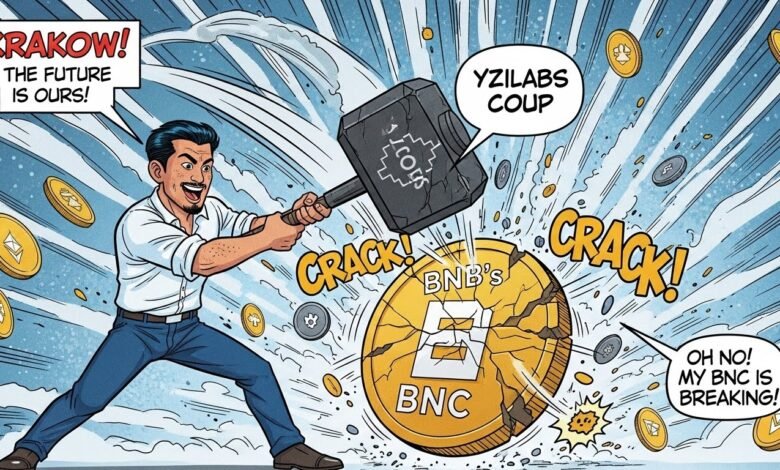
In early December 2025, Changpeng Zhao-backed YZiLabs stunned the crypto and equity markets by launching what amounts to a full-blown boardroom coup against BNB treasury firm BNC, the Nasdaq-listed company that holds one of the world’s largest corporate treasuries of BNB. The move caps a whirlwind year in which BNC, formerly CEA Industries, pivoted from its legacy business into a BNB-focused corporate treasury strategy backed by a massive $500 million private raise and a high-profile partnership with YZiLabs.
Now the partnership has turned into open warfare. If successful, the campaign would effectively hand control of the BNB treasury giant to Zhao’s family office.
At the heart of the conflict are allegations of weak governance, delayed regulatory filings, sluggish execution of BNC’s BNB strategy, and a widening discount between the company’s share price and the net asset value of its BNB holdings. Meanwhile, BNC’s leadership has responded with a public statement reaffirming its commitment to the BNB DAT strategy and telling shareholders they do not need to take any action yet, clearly signaling that a prolonged proxy fight may be ahead.
In this article, we will unpack how the boardroom coup unfolded, what YZiLabs is demanding, how BNC is defending itself, and what this high-stakes governance battle could mean for BNB, corporate treasuries, and crypto investors.
How BNC Became the World’s Flagship BNB Treasury
To understand the significance of the coup, you first need to understand what BNC has become over the past year.
From PIPE deal to proxy fight
According to recent public filings and media reports, YZiLabs began raising concerns about BNC’s performance and governance in the months following the PIPE transaction and treasury expansion. The firm reportedly pressed BNC for faster execution, more transparent investor communications and timely filings with regulators.
Instead, YZiLabs says it encountered delays, missed or late disclosures and a lack of clear, institution-focused outreach. At the same time, BNC’s share price began to slide even as its underlying BNB holdings remained substantial. That gap between the company’s market value and the net asset value (NAV) of its BNB treasury became a central grievance.
By early December, YZiLabs had transitioned from private advocacy to public confrontation, initiating what many outlets or analysts are openly calling a boardroom coup.
Schedule 14A and the power of written consent
The mechanism YZiLabs chose is a classic activist tool in U.S. markets: a preliminary Schedule 14A consent solicitation filed with the Securities and Exchange Commission. The filing essentially asks shareholders to sign a “white consent card” approving YZiLabs’ proposals without waiting for a formal shareholder meeting. The proposals reportedly include several core elements that define the coup attempt.
YZiLabs wants to expand BNC’s board of directors and fill the new seats with its own nominees. It seeks to roll back or repeal any bylaw amendments made after a specific date in mid-2025, which it suggests were designed to entrench the current board.
It aims to reset the governance framework so that shareholders can more easily influence the board in the future. If a majority of outstanding shares deliver written consents, these changes would take effect and effectively transfer control of the BNB treasury firm BNC into YZiLabs’ hands.
What YZiLabs is accusing BNC of
The rhetoric from Changpeng Zhao-backed YZiLabs has focused on three broad themes: governance, execution and value destruction.
Governance and disclosure failures
In its campaign materials and the Schedule 14A, YZiLabs accuses BNC’s current leadership of failing to meet basic governance and disclosure standards expected from a Nasdaq-listed company managing billions of dollars in crypto assets.
Key allegations include delayed or incomplete public filings that left investors in the dark about key treasury developments, a fragmented and often late investor relations effort that did not match the scale of BNC’s BNB holdings, and potential conflicts of interest linked to outside ventures and influential shareholders, including firms that hold both board seats and large equity stakes.
These concerns are particularly sensitive in the crypto sector, where past scandals have already made regulators wary of opaque governance at digital-asset companies.
The widening NAV discount and shareholder frustration
A core argument in YZiLabs’ coup narrative is the NAV discount. BNC, as a BNB treasury vehicle, holds a large pool of BNB whose market value can be calculated relatively easily. If the company’s share price trades significantly below the per-share value of its BNB holdings, investors are effectively pricing in governance risk, operational problems or a lack of confidence in management.
Reports indicate that BNC shares have slumped sharply in recent months, even as the company’s BNB holdings remain sizable. One analysis cites a stock price decline of more than ninety percent from previous peaks and notes that BNC’s shares have been trading at a steep discount to the estimated value of its BNB treasury.
For an activist investor like YZiLabs, that discount is both a warning sign and an opportunity. The firm argues that with stronger governance, faster execution and better communication, BNC’s valuation could more closely track its underlying BNB assets, unlocking value for existing shareholders.
How BNC is responding to the coup attempt
BNC has not stayed silent. Shortly after news of the boardroom coup at BNB treasury firm BNC broke, the company issued a formal response.
Reaffirming the BNB DAT strategy
In a GlobeNewswire release, CEA Industries Inc. (still the legal name behind the BNC ticker) acknowledged YZiLabs’ campaign but reaffirmed its commitment to its BNB DAT strategy and to the broader BNB-focused treasury model. The statement emphasized BNC’s intention to keep building its BNB treasury, refine its operations and pursue shareholder value over the long term.
Crucially, the company told shareholders they “do not need to take any action” in response to YZiLabs’ materials at this stage. That language is typical of companies facing an activist challenge and suggests BNC is preparing to campaign for shareholder support in opposition to YZiLabs’ consent solicitation.
Painting YZiLabs as opportunistic
Although BNC’s public language has been relatively measured, the underlying implication is clear: management believes it has a credible plan and that Changpeng Zhao-backed YZiLabs is trying to seize control of a valuable BNB treasury at a moment of market stress. By positioning itself as the responsible steward of the world’s largest public BNB treasury, BNC is hoping to convince institutional and retail investors that continuity is safer than a sudden, activist-led overhaul.
This sets up a classic governance showdown in which both sides claim to be defending shareholder interests.
Market reaction: BNB price moves and investor sentiment
Any time a major treasury vehicle experiences a boardroom coup, markets pay attention. The Changpeng Zhao-backed YZiLabs offensive against BNC has already had visible effects.
BNB’s price under pressure
BNB, the native token associated with Binance and BNB Chain, has come under moderate pressure around the time of the coup headlines. Reports cite a short-term drop of around one to two percent in BNB’s price, accompanied by a spike in trading volume as traders tried to price in governance risk at one of the coin’s largest corporate holders.
While this move is small compared to BNB’s long-term volatility, it underscores how closely the market watches any large holder with systemic significance. If investors fear forced sales, legal disputes or prolonged uncertainty at a BNB treasury firm, they may demand a higher risk premium on the token itself.
BNC as a leveraged BNB governance trade
BNC’s own stock has been even more volatile. Because it owns large amounts of BNB while trading like a small-cap equity, it effectively acts as a leveraged governance and sentiment bet on both BNB and the competence of its board.
For traders, the boardroom coup at BNB treasury firm BNC creates a complex trade. A successful YZiLabs campaign might:
Elevate expectations of tighter governance and more aggressive strategies to close the NAV discount, potentially boosting BNC’s stock.
Reinforce the narrative that activists can unlock value in crypto treasuries, encouraging similar campaigns elsewhere.
Conversely, a long, messy fight could:
Keep the NAV discount wide as investors remain uncertain about who will ultimately control the company.
Increase the perceived risk around concentrated BNB treasuries, particularly if any forced restructuring or asset sales are seen as possible.
Why this coup matters for crypto corporate governance
Beyond the immediate price swings, the Changpeng Zhao-backed YZiLabs move has broader implications for how crypto-native firms interact with public markets and traditional activist investors.
Crypto meets classic Wall Street activism
Activist campaigns, proxy fights and consent solicitations are nothing new in traditional equity markets. What makes this case unusual is that the target is a publicly traded company whose primary asset is a volatile crypto token and whose major backer is one of the industry’s most influential figures.
This means that classic Wall Street tools such as Schedule 14A filings, consent cards and bylaw battles are being deployed over the future of a BNB treasury vehicle that is deeply embedded in the broader BNB ecosystem. For many observers, this marks a new phase in crypto’s maturation, where governance disputes look less like social media feuds and more like structured corporate warfare.
Lessons for founders, token holders and treasuries
The BNC saga offers several important lessons.
First, if a company chooses to build its identity around a single-token treasury, it must maintain exceptionally high standards of transparency, disclosure and investor communication. Any gap between the value of its holdings and its market price will be scrutinized.
Second, partnering with heavyweight investors like Changpeng Zhao-backed YZiLabs brings not only capital and credibility but also accountability. If performance lags or governance looks weak, those investors may not hesitate to leverage activist tools.
Third, for BNB holders and DeFi builders, the case highlights how off-chain legal and governance structures can shape on-chain ecosystems. A mismanaged treasury could contribute to volatility or confidence shocks, while a well-run one can act as a stabilizing anchor.
Possible outcomes and scenarios for BNC and YZi Labs
As of now, the outcome of the boardroom coup at BNB treasury firm BNC is undecided. Several scenarios are plausible.
Negotiated settlement

Many activist campaigns end not with a total victory or defeat but with a compromise. BNC might agree to add one or more YZi Labs nominees to the board, adjust certain bylaws or commit to specific governance improvements in exchange for YZi Labs withdrawing its consent solicitation.
Such a settlement would let both sides claim partial victory. YZi Labs could argue it catalyzed positive change, while BNC management could point to continuity and stability.
Full or partial board turnover
If YZiLabs succeeds in securing written consents from a majority of shareholders, it could reshape the board far more dramatically. A YZiLabs-dominated board might pursue strategies such as buybacks to close the NAV discount, accelerated BNB acquisitions or divestitures, or strategic partnerships to monetize BNC’s treasury position.
That could create a very different risk-return profile for BNC’s stock and potentially change how the market values other crypto treasury vehicles.
Entrenchment and prolonged conflict
A less optimistic scenario would see BNC and Changpeng Zhao-backed YZiLabs locked in a prolonged, adversarial battle. Legal challenges, competing communication campaigns and ongoing governance disputes could keep uncertainty elevated, potentially widening the NAV discount and leaving investors stuck in limbo.
For now, much will depend on how large institutional holders, retail investors and index funds interpret the situation and which side they trust to manage the world’s flagship BNB treasury.
Conclusion
The clash between Changpeng Zhao-backed YZiLabs and BNB treasury firm BNC is more than a single-company drama. It is a high-profile stress test of what happens when crypto-native assets, traditional corporate structures and activist governance collide.
BNC’s evolution from CEA Industries into a BNB-focused treasury vehicle was bold, and the involvement of YZiLabs gave the story immediate legitimacy. But as the boardroom coup unfolds, it is clear that large investors are no longer willing to simply trust the narrative. They want hard evidence of strong governance, clean disclosures and an unwavering commitment to shareholder value.
Whatever the final outcome, this battle will likely shape how future BNB treasuries, token-backed corporations and crypto-focused public companies design their boards, communicate with investors and engage with powerful backers. For BNB holders, equity investors and DeFi participants alike, the BNC-YZiLabs saga is a reminder that in modern crypto markets, on-chain value and off-chain governance are inseparable.
See more;Changpeng Zhao’s YZiLabs Coup Rocks BNB Treasury BNC