Bitcoin’s Nvidia Rally Fades as Price Hits $88K
Bitcoin’s Nvidia-fueled surge fades fast as BTC slides back to $88K. Discover what went wrong, why the rally failed, and what it means for traders now.

Bitcoin’s Nvidia Rally. For a brief moment, Bitcoin seemed unstoppable. Riding a wave of enthusiasm from Nvidia’s explosive AI-driven stock surge, the leading cryptocurrency pushed higher as traders drew parallels between the AI boom and the digital asset market. Headlines celebrated Nvidia-led gains across risk assets, and Bitcoin briefly appeared ready to sustain a powerful breakout. But the optimism did not last. Very quickly, Bitcoin’s Nvidia-led gains proved short-lived, with price slumping back to $88K, leaving traders stunned by the speed of the reversal.
This kind of sharp, emotionally charged move is nothing new for Bitcoin. The market has a long history of overreacting to macro narratives, tech sector rallies and institutional headlines. Bitcoin’s Nvidia Rally
In this article, we will explore why Bitcoin’s Nvidia-fueled rally faded so quickly, what really drove the price down from the highs, and what the retracement to $88K could mean for the next phase of the market. We will also look deeper into the relationship between Bitcoin, Nvidia, AI stocks, institutional flows, market structure, on-chain metrics and macroeconomic conditions, providing a comprehensive picture for traders and long-term investors alike.
Table of Contents
ToggleThe Nvidia Effect: How AI Euphoria Spilled Into Bitcoin
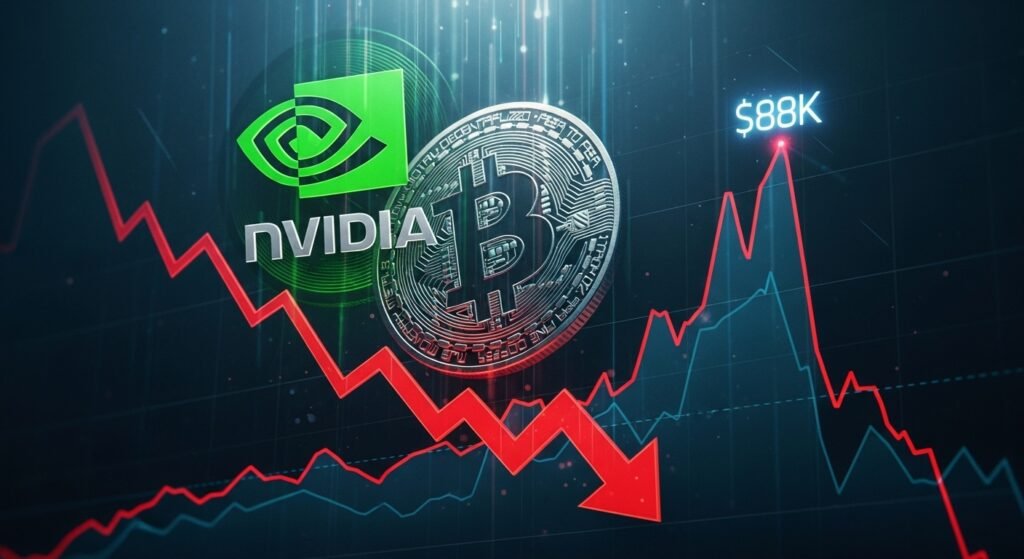
Why Nvidia’s Rally Influenced Bitcoin in the First Place
Nvidia has become the flagship stock of the AI revolution, and its rally has often been seen as a bellwether for risk appetite. When Nvidia posts record earnings or announces strong GPU demand for AI workloads, traders frequently rotate into other high-beta assets such as tech stocks, growth names and cryptocurrencies like Bitcoin. Bitcoin’s Nvidia Rally.
This time was no different. As Nvidia shares jumped on strong earnings and bullish guidance, crypto traders framed the move as a validation of the broader technology and innovation trade. The logic was simple: if AI and high-performance computing are thriving, the digital economy is accelerating, and scarce digital assets such as Bitcoin should benefit as well.
For a short period, Bitcoin’s price surged in tandem with Nvidia, driven not only by spot buying but also by aggressive derivatives positioning. Funding rates climbed, open interest increased and social media buzz tied Bitcoin’s move directly to Nvidia’s performance. The narrative was that Bitcoin would join the “AI trade” as a kind of macro bet on the future of digital infrastructure. Bitcoin’s Nvidia Rally.
Narrative Momentum vs. Fundamental Reality
However, narrative-driven rallies in Bitcoin can be fragile. While Nvidia’s fundamentals are anchored in tangible demand for AI chips, Bitcoin’s price movement is far more sentiment-driven and liquidity-sensitive. The rally inspired by the Nvidia-led risk-on mood was built on quick speculation rather than long-term repositioning.
As soon as the narrative momentum cooled, and profit-taking hit Nvidia and broader equities, Bitcoin’s correlation to tech stocks turned from tailwind to headwind. What looked like a sustainable breakout rapidly turned into an overextended move that needed to correct. The result was a sharp downside reversal that dragged Bitcoin back toward the $88K level.
Why Bitcoin’s Price Slumped Back to $88K
Overleveraged Longs and a Brutal Liquidation Cascade
One of the main reasons Bitcoin’s Nvidia-led gains proved short-lived is the classic problem of excessive leverage in the derivatives market. When prices rise quickly, traders often pile into long positions using leverage on futures and perpetual swaps. This creates a precarious setup where even a modest pullback can trigger forced liquidations. Bitcoin’s Nvidia Rally.
As Bitcoin began to stall at the top of the Nvidia-inspired rally, a wave of profit-taking hit the market. That initial selling pressure caused prices to slip just enough to start liquidating overleveraged long positions, which in turn amplified the move lower. Each liquidation added to the selling pressure, creating a cascading effect that accelerated the drop.
Within a short period, Bitcoin had retraced back to the $88K zone, turning what appeared to be a healthy breakout into a painful reminder of how quickly the crypto market can punish late bullish sentiment and overextended leverage.
Profit Taking After Nvidia’s Peak Sentiment
At the same time, Nvidia’s own rally began to cool as traders locked in gains after a powerful run. When the leading AI stock stops climbing, it often signals a pause in broader risk-on positioning. Investors rotate into safer assets, trim exposure to speculative sectors and reduce leverage across portfolios.
As Nvidia’s momentum faded, Bitcoin lost its narrative anchor. What had been described as a new chapter of AI-fueled digital asset growth suddenly looked like another short-lived hype cycle. This shift in perception prompted both institutional desks and retail traders to reduce positions, contributing to the slide back to $88,000. Bitcoin’s Nvidia Rally.
The Role of Macro: Rates, Liquidity and Risk Sentiment
Higher Rates and Tighter Liquidity Still Matter
Even though the AI boom and Nvidia’s earnings dominated headlines, the broader macroeconomic backdrop remains critical for Bitcoin. Central bank policy, real interest rates, inflation data and dollar strength all heavily influence how much risk investors are willing to take.
If bond yields remain elevated or policymakers hint at keeping rates higher for longer, risk assets like Bitcoin and high-growth tech stocks tend to struggle. Even a strong micro narrative, such as AI adoption or GPU demand, can be overshadowed by macro headwinds.
During the Nvidia-led rally, some of these macro risks were temporarily ignored. But as the dust settled, traders reassessed the environment. Concerns over liquidity, potential future rate hikes or slower growth reemerged, creating a less supportive backdrop for Bitcoin to sustain prices above $88K.
Risk-On vs. Risk-Off: Where Bitcoin Fits Today

Bitcoin has gradually shifted from a purely speculative asset toward a macro-sensitive hybrid, trading at times like digital gold, and at other times like a high-beta tech stock. When the market leans risk-on, Bitcoin often outperforms. But when investors move into a risk-off positioning, Bitcoin can see sharp declines as capital flows into cash, bonds or more defensive equities. Bitcoin’s Nvidia Rally.
The retreat back to $88,000 is a reflection of this dynamic. As enthusiasm for Nvidia cooled and macro worries resurfaced, the broader risk-off mood spilled into Bitcoin, revealing that the recent surge was not yet backed by a durable shift in long-term capital allocation.
On-Chain Signals: What the Blockchain Data Suggests
Long-Term Holders vs. Short-Term Speculators
While price action tells one story, on-chain data provides deeper insight into how different classes of Bitcoin holders are behaving. During the Nvidia-led surge, short-term holders and new entrants were quick to chase the move, increasing realized profits and short-term spending.
In contrast, a large portion of long-term holders appeared relatively calm. Many did not aggressively sell into the rally, indicating that they see Bitcoin’s fair value as higher than the current $88K region, or that they are anchored to even longer-term cycles such as the halving schedule and broader adoption trends.
This divergence between long-term conviction and short-term speculation helps explain the volatility. The slump back to $88K hurt recent buyers and leveraged traders the most, while long-term holders largely continued to accumulate or hold, reinforcing the long-term structural support underlying the asset.
Exchange Flows and Liquidity Pockets
Another important on-chain metric is exchange inflows and outflows. When a large amount of Bitcoin moves onto exchanges, it usually signals potential selling pressure. Conversely, outflows to cold storage or custodial solutions tend to reflect long-term accumulation. Bitcoin’s Nvidia Rally.
Around the Nvidia-led rally and subsequent correction, there were signs of elevated exchange inflows, which aligned with increased realized profits and some degree of panic-selling as the price reversed. Liquidity clusters formed near critical price levels, and once the $88K area was retested, it became a decisive level where both buyers and sellers interacted heavily.
This suggests that $88,000 is more than just a random retracement point. It may serve as a short- to medium-term pivot zone, where the market decides whether Bitcoin will stabilize, accumulate strength or continue to correct further.
Technical Outlook: Is $88K a Support or a Warning Sign?
Key Levels Traders Are Watching
From a technical analysis perspective, the slump back to $88K has transformed that level into a critical reference point. If Bitcoin can hold above it and form a base, the Nvidia-led rally may be remembered as a volatile shakeout rather than a major top. However, if price loses this level decisively, it could open the door to a deeper correction. Bitcoin’s Nvidia Rally.
Traders are closely monitoring several factors around this zone. The way Bitcoin behaves around this level over the coming days and weeks will likely shape the next directional move.
Short-Term Volatility vs. Long-Term Trend
It is important to distinguish between short-term volatility and the long-term trend. Nvidia-led gains may have proven short-lived, but that does not automatically signal the end of Bitcoin’s broader cycle. Historically, Bitcoin has experienced multiple sharp corrections even during powerful bull markets.
If the long-term structure of higher highs and higher lows remains intact, the retracement to $88,000 could simply be a standard correction in a volatile uptrend. However, traders and investors must remain cautious, as a failure to reclaim higher levels with conviction could gradually erode market confidence and shift momentum toward a more prolonged consolidation or downtrend. Bitcoin’s Nvidia Rally.
Investor Psychology: The Emotional Side of the $88K Pullback
FOMO, Euphoria and the Pain of Buying the Top
The Nvidia-inspired rally was characterized by FOMO (fear of missing out), with many retail traders entering late as social media and news coverage amplified the narrative of AI, GPUs and digital assets moving together. When Bitcoin began to soar in step with Nvidia, some investors assumed that the move would be sustained, ignoring the risks of entering during an already extended phase.
As price reversed and slumped back to $88K, those who bought near the top experienced immediate drawdowns. This can be emotionally taxing, often leading to panic selling or a loss of trust in the asset. Such emotional swings are part of what keeps Bitcoin volatile. The constant tug-of-war between greed and fear continues to define the market structure, especially during high-profile, narrative-driven moves. Bitcoin’s Nvidia Rally.
How Smart Money Uses These Reversals
More experienced investors and institutional players often view such sharp pullbacks differently. Instead of reacting emotionally, they analyze whether the underlying fundamental and structural trends have changed. If long-term adoption, regulatory clarity, institutional participation and on-chain accumulation remain healthy, a retracement to zones like $88,000 might be seen as an opportunity rather than a catastrophe.
In many previous cycles, smart money accumulated Bitcoin during periods of fear and confusion, particularly after failed breakouts or narrative-driven disappointments. While Nvidia’s rally may have created unrealistic expectations, the correction has also reset some leverage and cooled down overheated sentiment, potentially laying groundwork for a more sustainable move in the future.
What Bitcoin’s Nvidia-Led Reversal Means Going Forward
Decoupling from Single-Stock Narratives
One of the key lessons from this episode is that Bitcoin cannot rely on single-stock narratives like Nvidia’s rally to sustain long-term price appreciation. While correlations with AI stocks and tech names may create short bursts of momentum, they are not a substitute for organic adoption, regulatory clarity and continued institutional integration.
Going forward, Bitcoin’s healthiest path may involve gradually decoupling from short-lived hype cycles and focusing more on its own strengths: a fixed supply, decentralized network, growing infrastructure, and increasing usage as both a store of value and a speculative trading instrument. Bitcoin’s Nvidia Rally.
The Importance of Patience and Risk Management
The slump back to $88K also underscores the importance of risk management.
For long-term investors, events like these are reminders that Bitcoin’s journey is rarely linear. Even when the macro backdrop, tech sector and AI narratives seem supportive, there will be periods of sharp volatility. Patience, conviction based on solid research and a well-defined strategy tend to outperform reactive, narrative-chasing behavior over the long run.
Conclusion
Bitcoin’s Nvidia-led gains have proven decidedly short-lived, with the price slumping back to $88K and erasing much of the excitement generated by AI and GPU-driven optimism. The rapid reversal highlights how fragile narrative-based rallies can be, especially in a market dominated by leverage, sentiment and global liquidity conditions. Bitcoin’s Nvidia Rally.
Yet the pullback does not necessarily spell doom for Bitcoin’s long-term outlook. On-chain data suggests that long-term holders remain relatively steady, macro factors are still in flux, and the broader digital asset ecosystem continues to mature. Nvidia’s rally may have been an imperfect catalyst, but it also showed that Bitcoin still sits at the heart of the global risk asset conversation. Bitcoin’s Nvidia Rally.
Ultimately, the lesson for traders and investors is clear: do not rely solely on external narratives, whether they come from AI stocks, Nvidia earnings or tech sector euphoria. Instead, focus on Bitcoin’s intrinsic dynamics, from adoption and regulation to on-chain trends and market structure. The $88,000 retracement is another chapter in Bitcoin’s volatile story, not the final word. Bitcoin’s Nvidia Rally.
FAQs
Q. Why did Bitcoin’s Nvidia-led gains fade so quickly?
As soon as enthusiasm around Nvidia’s earnings cooled and traders started taking profits, Bitcoin faced selling pressure. Excessive leverage in the derivatives market added fuel to the decline, triggering liquidations and accelerating the slump back to $88K.
Q. What does Bitcoin slumping back to $88K mean for the trend?
The move back to $88,000 is significant, but not necessarily catastrophic. It may represent a normal correction within a larger uptrend, especially if Bitcoin can hold above this level and build support. Traders are watching how price behaves around this zone to determine whether it becomes a solid base for future moves or a stepping stone to a deeper correction.
Q. How is Nvidia related to Bitcoin’s price action?
When Nvidia rallies, it can encourage a broader risk-on environment, prompting some traders to rotate into speculative assets like Bitcoin. However, this relationship is indirect and largely sentiment-driven, meaning it can create short-lived correlations rather than stable, long-term price drivers.
Q. Are long-term Bitcoin holders worried about the drop to $88K?
On-chain data typically shows that long-term Bitcoin holders are less reactive to short-term price swings. Many of them have experienced multiple cycles with far larger percentage drawdowns. While the slump to $88K may concern recent buyers, long-term holders often focus on broader structural factors such as adoption, regulation, halving cycles and institutional interest rather than day-to-day volatility.
Q. What should traders learn from this Nvidia-led Bitcoin rally?
Traders should learn that chasing narrative-driven rallies without a clear risk management plan can be dangerous. The Nvidia-led move showed how quickly sentiment can flip and how leverage can amplify reversals. Going forward, traders may benefit from using measured leverage, clear stop-losses and realistic expectations, while paying attention not just to external headlines, but to Bitcoin’s own on-chain signals, liquidity conditions and technical structure