Panic Warning: Bitcoin Crashes Under $90K – Early Warning of Risk-Asset Meltdown?
Bitcoin crashes under $90K, sparking panic and fears of a wider risk-asset meltdown. Learn what this means for crypto, stocks, and your portfolio now.

As Bitcoin crashes under $90K, investors across the world are asking the same urgent question: is this just another healthy correction, or the first tremor of a full-blown risk-asset meltdown?
For years, Bitcoin has been hailed as digital gold, a hedge against inflation and a revolutionary form of money. At the same time, it has behaved like a classic high-beta risk asset, moving aggressively up and down with global liquidity and investor sentiment. When Bitcoin rips higher, traders talk about a new era of wealth. When it plunges, the panic spills over into altcoins, tech stocks, and speculative assets everywhere.
Now, with the Bitcoin price slipping under $90K, the mood has flipped from euphoria to fear. Crypto bulls who were confidently predicting six-figure targets are suddenly reevaluating their risk. Traditional investors who once dismissed Bitcoin are paying close attention, because its violent moves often foreshadow stress across the broader financial markets.
In this in-depth guide, we will explore why Bitcoin’s drop below $90K matters far beyond the crypto world, how it can act as an early warning signal for a risk-asset crash, and what smart investors can do to protect themselves without reacting emotionally. You’ll learn how macro forces, leverage, derivatives, regulation, and sentiment all interact to create the kind of volatility we’re seeing now.
Table of Contents
ToggleWhy Bitcoin Under $90K Matters
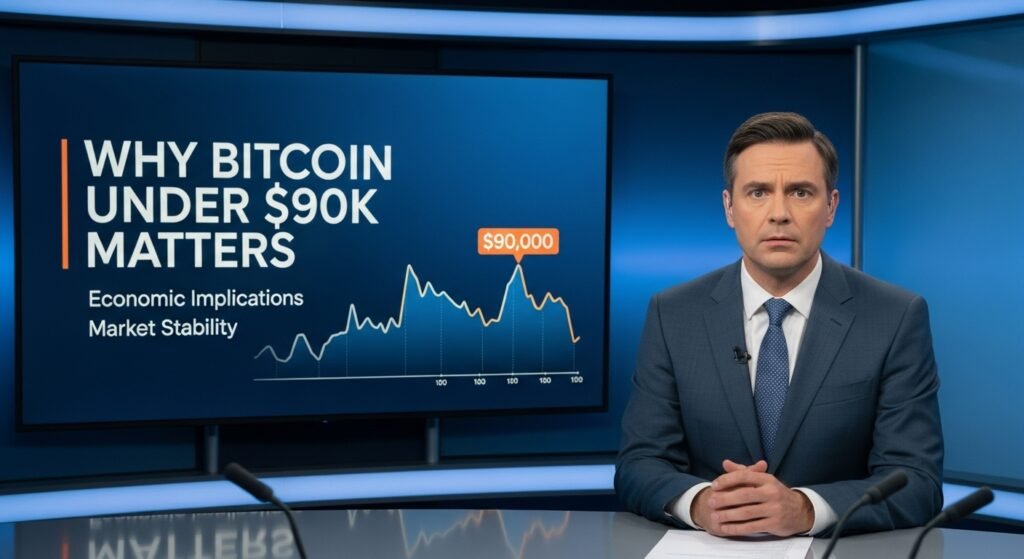
When Bitcoin crashes under $90K, it is not just another price level on a chart. It represents a psychological breaking point for many traders and institutions. In the minds of investors, round numbers like $100K and $90K become symbolic milestones. Holding above those levels reinforces confidence; breaking below them can trigger fear and forced selling.
For months, analysts had framed $90K as a key support zone — an area where buyers had previously stepped in aggressively. Once that line failed, short-term traders were squeezed, leveraged positions were liquidated, and the drop accelerated. This creates a feedback loop: falling prices trigger more liquidations, which trigger further declines.
Bitcoin’s role as the flagship cryptocurrency makes this even more important. When the largest and most established digital asset is flashing weakness, the signal spreads to Ethereum, altcoins, DeFi tokens, meme coins, and even crypto-related stocks. The narrative shifts from “buy the dip” to “protect capital,” especially among big players like funds and proprietary trading firms.
In other words, Bitcoin slipping beneath $90K is not an isolated event. It is a signal that risk appetite is changing, and that shift often reaches far beyond the crypto charts.
How Bitcoin Became the Barometer of Risk Assets
To why people are talking about an impending risk-asset meltdown, you have to how Bitcoin transformed from a niche experiment into a global macro barometer.
From Fringe Asset to Mainstream Indicator
In its early years, Bitcoin traded independently of stocks, bonds, or commodities. Volumes were small, and participants were mainly tech enthusiasts and early adopters. Over time, as institutional investors entered the market and Bitcoin ETFs, futures, and options grew, BTC became deeply integrated into the broader financial system. That is why a sharp move like Bitcoin crashing below $90K can be seen as an early signal that risk was priced too optimistically and is now being repriced lower.
Correlation With Stocks and Tech
During periods of stress, Bitcoin’s correlation with major equity indices has often spiked. Instead of acting like a pure safe-haven asset, BTC has traded more like a high-beta tech stock. When the NASDAQ falls sharply, Bitcoin frequently follows, sometimes with amplified intensity. Thus, Bitcoin under $90K is more than a crypto story. It can be interpreted as a barometer of how willing investors are to hold volatile, speculative assets in general.
Drivers Behind the Bitcoin Crash Below $90K

To judge whether this move is the start of something bigger, we need to look at the forces pushing Bitcoin below $90K in the first place.
Macro Headwinds: Interest Rates, Inflation and Liquidity
One of the strongest drivers of crypto market crashes is macro policy. When central banks raise interest rates or signal tighter monetary policy, the appeal of risk assets tends to fall. Investors can suddenly earn more on “safe” assets like cash and government bonds, so they reduce exposure to speculative plays like crypto.
At the same time, persistently elevated inflation can create uncertainty. While some argue that Bitcoin is a hedge against inflation, the reality is more complex. In practice, when inflation is high and central banks are raising rates, the net effect often has been negative for Bitcoin, growth stocks, and other high-duration assets.
Put simply, when liquidity dries up, Bitcoin crashes under $90K are more likely to happen — and they can be sharper and more violent.
Leverage and Liquidations in the Crypto Ecosystem
When the market moves against highly leveraged players, you see a cascade of forced liquidations. Positions are sold automatically to meet margin calls, often at the worst possible moment. This can turn a normal correction into a sudden flash crash, dragging Bitcoin below key levels like $90K.
As these liquidations hit BTC, they often spill over into altcoins, DeFi protocols, and on-chain lending platforms. Collateral gets sold, stable coins de-peg, and liquidity dries up. This is where concerns about a system-wide risk-asset meltdown begin to feel more real.
Regulatory Shocks and Negative News
The crypto market is extremely sensitive to regulatory headlines. Sudden enforcement actions, bans, or lawsuits against major exchanges, stable coin issuers, or high-profile projects can trigger sharp sell-offs across the board. can magnify fear when Bitcoin is already under pressure. In those environments, investors tend to de-risk quickly, selling crypto along with speculative equities, high-yield bonds, and frontier assets.
Is This an Early Warning of a Risk-Asset Meltdown?
The core question many are asking as Bitcoin crashes under $90K is whether this move is a local shakeout or a global warning alarm.
Bitcoin as a Leading Indicator
Historically, Bitcoin has sometimes acted as a leading indicator of risk sentiment. Because the market trades 24/7 and is highly sensitive to liquidity, it can react faster than traditional exchanges.
If Bitcoin remains below $90K for an extended period, it suggests that buyers are not yet ready to step back in aggressively. That can be interpreted as an early stage of a broader risk-off rotation, where capital moves from speculative assets toward cash, bonds, defensive sectors, and safe-haven currencies.
Contagion to Crypto and Traditional Finance
In extreme scenarios, stress in leveraged crypto entities can spill over to traditional financial institutions with exposure through loans, derivatives, or balance-sheet holdings. While the system is stronger now than in the earliest days of Bitcoin, this channel of contagion remains a legitimate concern.
Investor Psychology: From Euphoria to Fear
Price levels like Bitcoin under $90K are just numbers until human emotions get involved. Then they become triggers for panic selling, FOMO buying, and emotional decision-making.
The Role of Narrative Shifts
These narrative shifts are powerful. They shape short-term trading decisions, long-term conviction, and public perception of crypto as an asset class. When fear dominates the narrative, liquidity dries up, spreads widen, and prices can overshoot to the downside, feeding the meltdown narrative.
Herd Behavior and Social Media
The modern crypto market is hyper-connected through social media, influencers, Telegram groups, and crypto Twitter. When a dramatic headline like “Bitcoin Crashes Under $90K – Panic Warning” starts trending, it can intensify herd behavior.
This kind of behavior can make price movements more extreme, amplifying both bearish and bullish phases. It’s one of the reasons that Bitcoin volatility is so famous — and why crashes in this asset can feel like the beginning of a wider risk-asset crisis.
How to Navigate a Bitcoin Crash Without Panicking
A drop like Bitcoin under $90K feels intense in the moment, but panic rarely leads to good decisions. While everyone’s situation is different, there are some guiding principles that can help investors think more clearly during a crypto market crash.
Reassessing Time Horizons and Risk Tolerance
If you bought Bitcoin purely as a long-term bet on digital scarcity, adoption and blockchain innovation, short-term fluctuations — even large ones — may matter less to your thesis. On the other hand, if you have high leverage or a large concentration in BTC and other volatile coins, a crash under $90K could represent a serious risk to your financial stability.
Diversification Beyond Crypto
If Bitcoin crashes below $90K and drags other speculative assets lower, diversified portfolios may absorb the shock more gracefully. It doesn’t eliminate risk, but it can help prevent a single asset from defining your financial future.
Focusing on Fundamentals, Not Just Price
During periods of fear, it is easy to focus only on price charts. Yet Bitcoin and the broader crypto ecosystem are also defined by fundamentals such as:
If these fundamentals remain strong or continue to improve, then price dips below $90K may eventually be seen as part of a broader long-term cycle rather than a permanent collapse. Conversely, if fundamentals deteriorate alongside price, the warning of a risk-asset meltdown becomes more serious.
(None of this is financial advice. Always do your own research and consider talking to a qualified financial professional before making investment decisions.)
Could This Crash Create the Next Big Opportunity?
History has shown that severe Bitcoin crashes can sometimes set the stage for major future rallies. Investors who kept their heads during past downturns and allocated capital carefully have often been rewarded when the market recovered.
The Contrarian View
Of course, being contrarian for its own sake is not a strategy. But that markets move in cycles of greed and fear can help you frame Bitcoin under $90K as one chapter in a longer story, not the final page.
Balancing Caution With Opportunity
The challenge for investors is to balance caution with openness to opportunity. On one side lies the risk of a deeper risk-asset meltdown, where crypto and other speculative assets continue to fall. On the other side lies the possibility that the current Bitcoin crash is a sharp but temporary shock within a longer structural uptrend.
Rather than trying to predict the exact bottom, some investors choose approaches like
Conclusion
The headline “Panic Warning: Bitcoin Crashes Under $90K – Early Warning of Risk-Asset Meltdown?” captures the anxiety many investors feel right now. Bitcoin’s drop below this psychologically important level is more than a random price fluctuation. It reflects a deeper shift in risk appetite, liquidity conditions, and market psychology.
Whether this move proves to be the first leg of a broader risk-asset crash or a violent but temporary shakeout, one thing is clear: the era of easy, one-way gains is over, at least for now. Investors must confront their own risk tolerance, reexamine their strategies, and pay attention to both macro forces and crypto-specific fundamentals.
Bitcoin crashing under $90K is a powerful reminder that volatility cuts both ways. It can create fear and losses for those overexposed and overleveraged, but it can also generate long-term opportunities for those who remain disciplined, diversified, and informed.
In the end, the question is not just what Bitcoin does next, but how you choose to respond to the warning it is sending about risk assets across the entire financial system.
FAQs
Q. Why is Bitcoin crashing under $90K causing so much panic?
Because Bitcoin has become a global barometer of risk appetite, a steep drop under $90K suggests that investors are rapidly de-risking. This can signal stress not only in crypto but also in tech stocks, growth equities, and other speculative markets, raising fears of a broader risk-asset meltdown.
Q. Does a Bitcoin crash always lead to a stock market crash?
Not always, but there is often a strong relationship. In recent years, Bitcoin has frequently moved in sync with high-growth and tech stocks. A sharp BTC decline can reflect or even anticipate a wider risk-off move, but many other factors—such as economic data, earnings, and central bank policy—also influence the stock market.
Q. Is Bitcoin still a good hedge if it drops below $90K?
Bitcoin’s role as a hedge is complex. It has sometimes acted as a hedge against currency debasement and long-term inflation, but in the short term it often behaves like a high-volatility risk asset. A price crash under $90K does not automatically invalidate the long-term thesis, but it does highlight that Bitcoin can be very unstable over shorter timeframes.
Q. How can I protect my portfolio during a Bitcoin crash?
Many investors respond to a crypto market crash by reassessing their allocation, leverage, and diversification. Keeping exposure to BTC and altcoins at a level that matches your risk tolerance, holding a mix of traditional assets, and avoiding excessive leverage can all help reduce the impact of volatility. It is also important to make decisions based on a clear plan, not short-term panic.
Q. Could the drop below $90K be a buying opportunity?
For some long-term investors, Bitcoin below $90K may be seen as an opportunity if they believe in the asset’s future and are comfortable with high volatility. However, there is no guarantee that prices will rebound quickly, and further downside is always possible. A cautious approach—such as incremental buying, strict position sizing, and maintaining diversification—can help manage the risks associated with trying to “buy the dip.